ANATOMY OF THE BACK
Your back – many structures working together
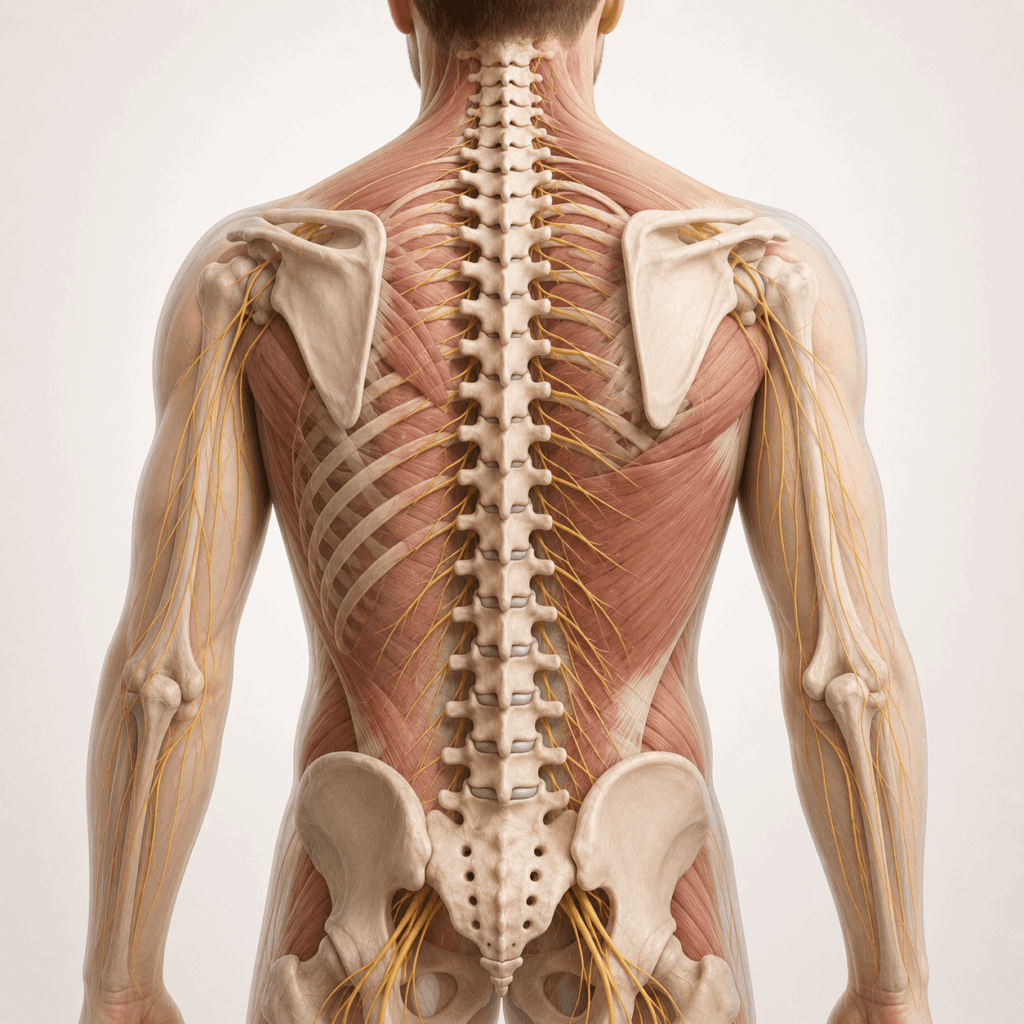
The spine forms the supporting framework of your back. Stability, mobility and resilience arise through its interaction with the intervertebral discs, muscles, joints, ligaments and nerves.
How your back works ↓
THE SUPPORTING FRAMEWORK
The spine – stable and mobile at the same time
The spine supports a large proportion of our body weight while also forming the body’s mobile axis. Its distinctive structure allows us to stand upright, turn, bend and absorb loads.
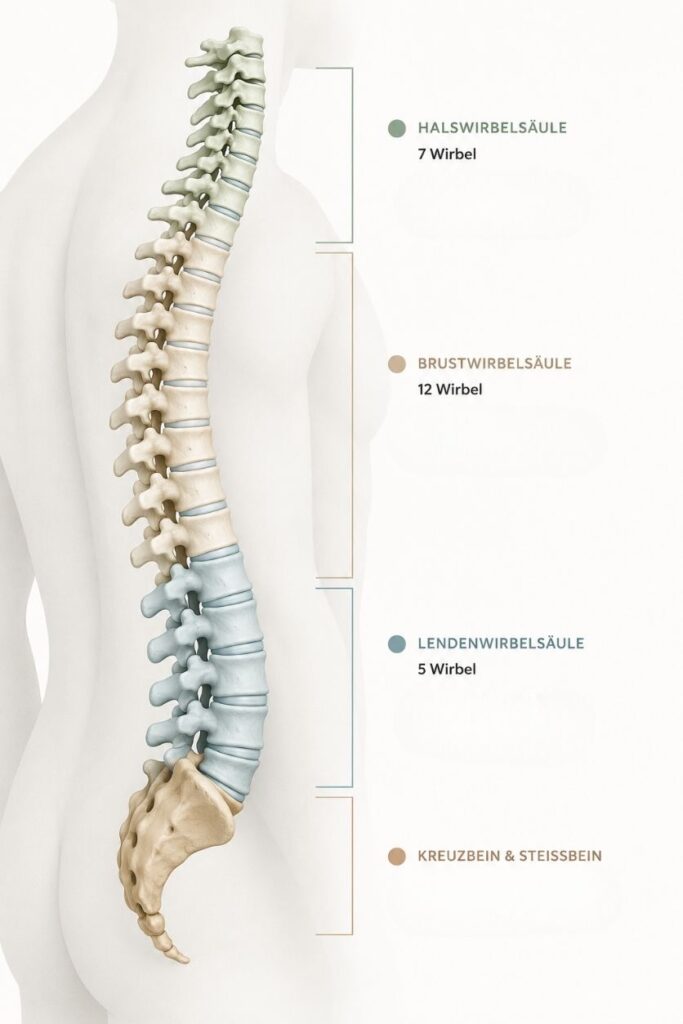
It consists of 24 movable vertebrae, the sacrum and the coccyx. Intervertebral discs lie between most of the movable vertebrae, while numerous small joints, ligaments and muscles guide and stabilise the spine.
– Cervical spine · 7 vertebrae – highly mobile and supports the head
– Thoracic spine · 12 vertebrae – connected to the rib cage and therefore more stable
– Lumbar spine · 5 vertebrae – bears substantial loads and has a particularly robust structure
– Sacrum and coccyx – connect the spine to the pelvis
Good to know: The spine’s natural S-shape helps distribute loads and absorb impact.
FLEXIBLE CUSHIONS
Intervertebral discs – absorbing and distributing load
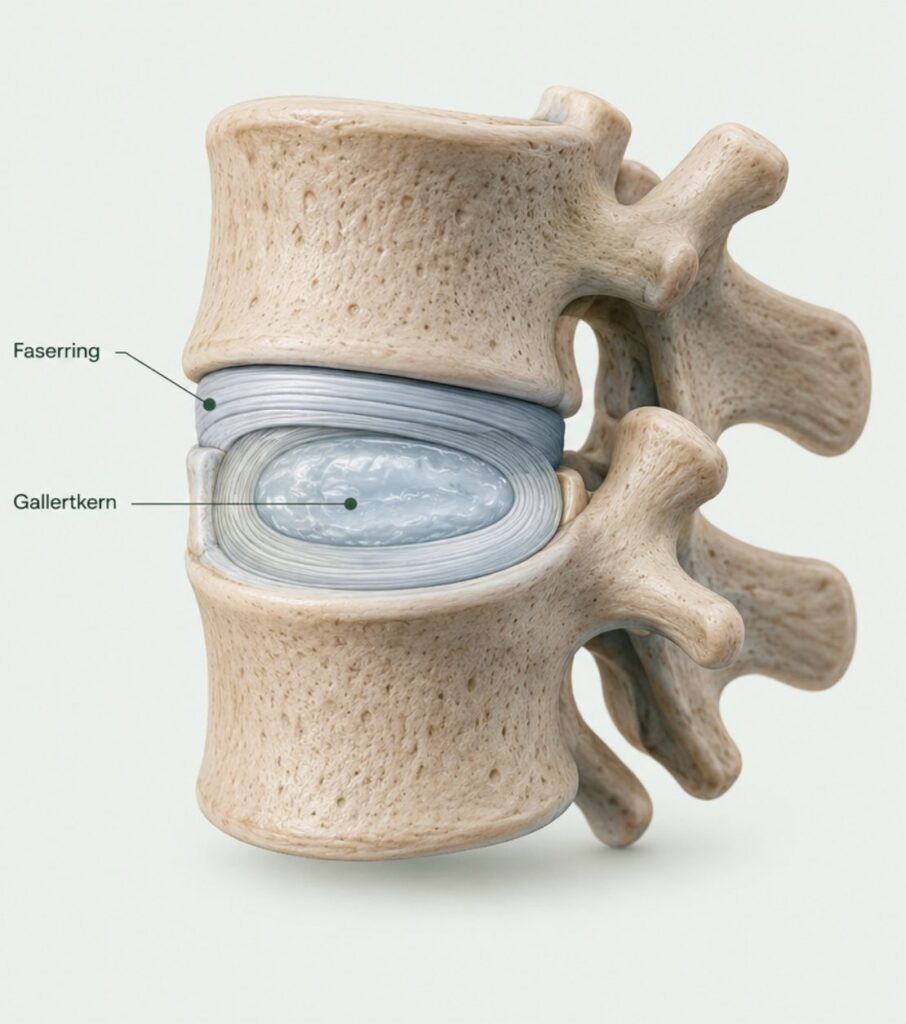
There are 23 intervertebral discs between the movable vertebrae. Each consists of a strong outer fibrous ring and a softer, water-rich gel-like centre.
Intervertebral discs help distribute pressure and load between the vertebrae. They also allow small movements between individual vertebrae, contributing to the mobility of the spine as a whole.
Loading ↔ unloading
Intervertebral discs change over the course of the day. They release fluid under load and absorb fluid again when the load is reduced. This natural cycle is part of normal disc function.
Good to know: Intervertebral discs have only a limited direct blood supply. Regular movement and varied loading support the exchange of nutrients and waste products within disc tissue.
Good to know: A resilient back does not simply require as much muscle strength as possible. It depends on a balanced combination of strength, mobility, coordination and regular movement.
ACTIVE STABILITY
Muscles – stabilising and moving your back
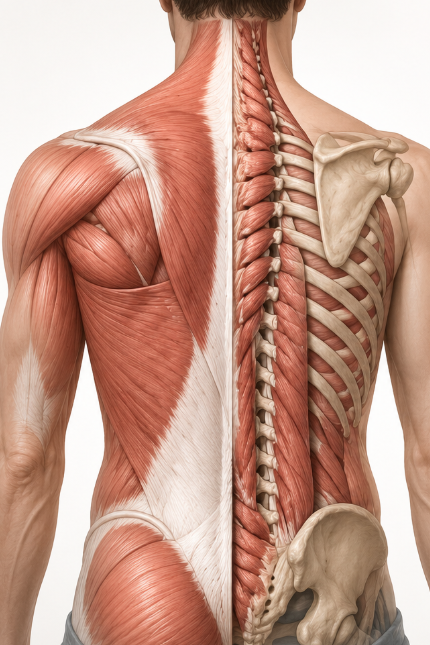
Your spine does not work in isolation. Numerous muscles around the back, abdomen and pelvis work together to keep the body upright, enable movement and stabilise the spine under load.
This involves more than the large, visible back muscles. The deeper muscles close to the spine play an important role in controlling and stabilising individual sections of the spine.
Two systems working together
Deep muscles
Located close to the spine, they support precise control and stabilisation of its individual sections.
Superficial muscles
They produce larger movements, keep the body upright and transfer forces between the trunk, arms and legs.
MOVEMENT & COMMUNICATION
Joints and nerves – moving, guiding and transmitting information
The vertebrae are connected by more than the intervertebral discs. Small facet joints at the back of the spine guide movement and, together with muscles and ligaments, contribute to stability.
The spinal cord runs inside the spine. Nerves emerge between the vertebrae and carry information between the brain and the body, including signals related to movement, touch and pain.
Facet joints
They connect adjacent vertebrae, guide movement and limit excessive motion.
Nerves
Nerve roots emerge from the sides of the spine and connect the spinal cord and brain with different areas of the body.
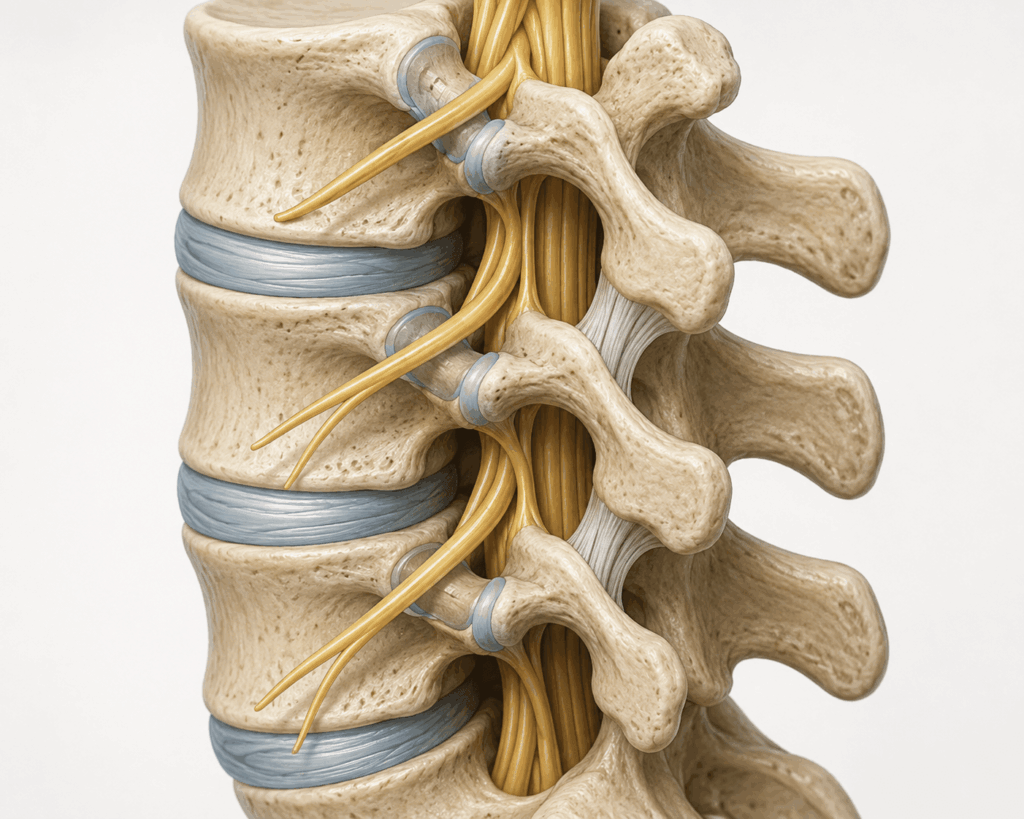
Good to know: Pain cannot always be clearly attributed to a single structure. How we perceive pain is also processed by the nervous system and influenced by various factors.
EVERYTHING WORKS TOGETHER
Your back works as a system
A healthy, resilient back does not depend on one structure alone. The spine, intervertebral discs, muscles, joints and nerves work together during every movement.
When you bend forwards, for example, the vertebrae move in relation to one another, the discs distribute load, the muscles control the movement, and the nervous system coordinates and processes information.
1. Movement
The joints and spine make movement possible.
2. Load
Intervertebral discs and other structures absorb and distribute forces.
3. Stabilisation
Muscles control movement and stabilise the trunk.
4. Control
The nervous system coordinates movement and processes information.
Back pain is complex
Changes in individual structures do not automatically mean that they are causing symptoms. Back pain can be influenced by the interaction of many factors, including load, movement, recovery and the way the nervous system processes information.
YOU UNDERSTAND THE ANATOMY – WHAT NEXT?
Why does back pain develop?
You now know the key structures of your back. Next, learn why symptoms can develop, which factors may play a role, and why a clinical or imaging finding often does not tell the whole story.
© 2026 Dieter Kofler
Legal Notice · Privacy Policy · Transparency